 Kelly Rainier
Moving to a new place is never easy, especially when you’re torn between two amazing Canadian options. Well, you’re not alone. Vancouver and Ontario both offer incredible opportunities, beautiful surroundings, and vibrant lifestyles – but in different ways.
The decision can feel overwhelming especially if you’re chasing career growth, wanting to slow down and be close to nature, or seeking the right place to raise a family.
In this guide, we’ll break down what it’s really like to live in each location to figure out which one fits your life best.
- Location, Climate & Natural Environment
- Real Estate Costs Vancouver vs Ontario
- Cost of Living Vancouver vs Ontario
- Career Opportunities Vancouver vs Ontario
- Lifestyle, Culture & Community
- Things to Do
- Education and Healthcare Vancouver vs Ontario
- Transportation & Accessibility Vancouver vs Ontario
- Which is Better? Vancouver or Ontario?
Location, Climate & Natural Environment
Vancouver

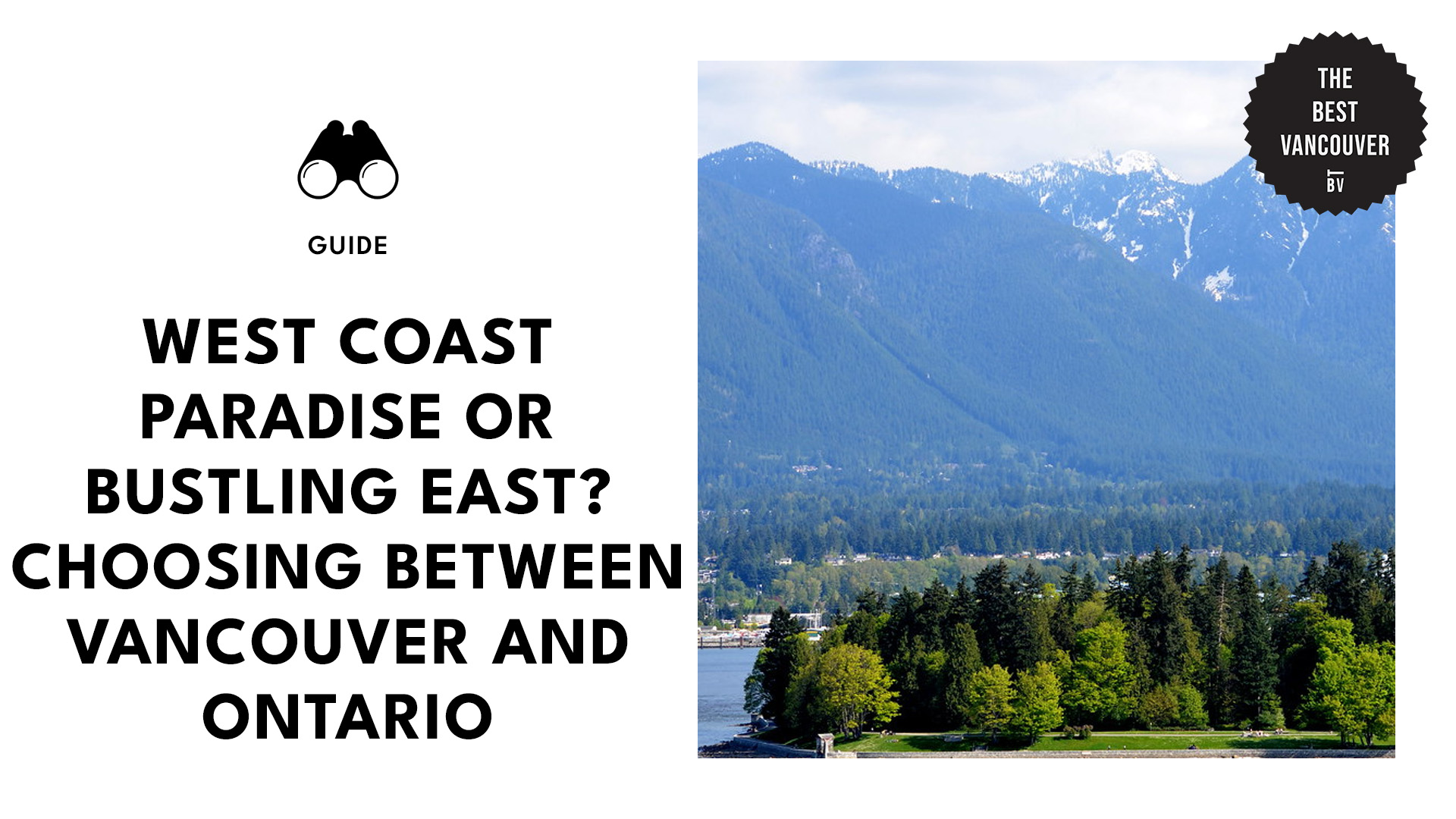
Located on Canada’s west coast in British Columbia, Vancouver is nestled between the Pacific Ocean and the Coast Mountains. Its unique geography provides stunning views and easy access to beaches, forests, and alpine trails.
This coastal city enjoys a temperate oceanic climate, with mild, rainy winters and warm, dry summers. Snowfall is rare at sea level but common in surrounding mountains.
The city is a paradise for outdoor enthusiasts, offering skiing, hiking, kayaking, and more within minutes of downtown.
Lush greenery year-round, a strong focus on environmental sustainability, and proximity to nature make Vancouver one of Canada’s most scenic cities.
Ontario

Ontario is located in east-central Canada and is the country’s most populous province. It stretches from the Great Lakes in the south to the boreal forests near Hudson Bay in the north.
The province has a varied climate. Southern cities like Toronto and Hamilton experience hot, humid summers and cold, snowy winters, while northern areas are significantly colder.
Known as “The Heartland Province,” it’s home to diverse landscapes, including lakes, rivers, forests, and farmland.
Iconic natural attractions like Niagara Falls, Algonquin Park, and the Muskoka region offer year-round recreational opportunities. Ontario’s natural environment supports both vibrant urban living and peaceful rural escapes.
Real Estate Costs Vancouver vs Ontario

Vancouver and Ontario both face high housing costs, but Vancouver consistently ranks as one of Canada’s most expensive markets. According to WOWA, the average home price in Vancouver in 2025 is at $1,211,073 CAD.
Home prices and rents in Vancouver are significantly higher, driven by population growth, strong demand and low supply, zoning restrictions, and foreign investments.
In Ontario, Toronto is also costly, but smaller cities like Ottawa, Hamilton, and London offer more affordable options. The average housing cost in Ontario is at $860,545 CAD, according to WOWA.
Overall, Ontario provides greater housing diversity and price flexibility, while Vancouver’s market presents challenges for first-time buyers and renters alike.
To give you an idea, here are the average costs for different types of housing in Vancouver and Ontario.
Average prices when buying a house in Vancouver and Ontario:
| City | Condo/Apartment | Townhouse | Detached home |
| Vancouver | $804,951 | $1,217,671 | $2,002,033 |
| Ontario | $549,000 | $620,000 | $1,431,495 |
When it comes to rent, the average cost in Vancouver is $2,301 CAD per month, while the average rent in Ontario is $1,897 CAD.
Here are the average prices when renting in Vancouver and Ontario by property type per month:
| City | Studio | One-Bedroom | 2-Bedroom | 3-Bedroom |
| Vancouver | $1,971 | $2,301 | $3,186 | $4,106 |
| Ontario | $1,547 | $1,897 | $2,284 | $2,684 |
Cost of Living Vancouver vs Ontario

The cost of living in Vancouver and Ontario have some notable differences depending on the city or region. In Vancouver, the cost of living with rent for a single person is at
$3,476 according to LivingCost.org.
Vancouver consistently ranks as one of Canada’s most expensive cities, particularly for housing, with high rental and homeownership costs.
Everyday expenses such as groceries, dining out, and gas also tend to be higher. However, public transit is efficient, and the mild climate can reduce heating expenses.
In Ontario, Toronto rivals Vancouver in terms of housing costs, but the province offers more affordability in cities like Ottawa, Hamilton, London, and Kitchener. The cost of living in Ontario is at $2,989 for a single person.
Groceries and services are generally more affordable in smaller Ontario cities, and there’s greater flexibility for different budgets. Meanwhile, utility costs can be higher due to colder winters.
In a major city like Toronto, the cost of living is almost the same as Vancouver at $3,428 as of March 2025, according to LivingCost.org.
Here’s a breakdown of essential monthly expenses for Vancouver and Ontario for a single person:
| Expense | Vancouver | Ontario |
| Rent and utilities | $2,206 | $1,868 |
| Food | $859 | $758 |
| Transport | $200 | $197 |
Monthly expenses in Vancouver and Ontario for a family of four:
| Expense | Vancouver | Ontario |
| Rent and utilities | $3,653 | $3,036 |
| Food | $2,223 | $1,983 |
| Transport | $523 | $506 |
Career Opportunities Vancouver vs Ontario

Both Vancouver and Ontario offer strong career opportunities, but in different fields. Vancouver has a growing tech industry, with in-demand roles in software development, data science, and digital media.
The city is also a hub for film and television production, green energy, and tourism. High-paying jobs in Vancouver include IT managers, engineers, and healthcare professionals.
Ontario, particularly in cities like Toronto and Ottawa, offers a broader range of job opportunities. Toronto is Canada’s financial center with high demand for finance professionals, legal experts, and corporate executives.
Meanwhile, Ottawa has a strong public sector and tech industry, with growing opportunities in cybersecurity and AI. Healthcare, skilled trades, and education are also in demand across the province.
To give you an idea, the average annual salary in Vancouver in 2025 is $72,351 CAD with the most experienced workers earning more than $130,000 CAD.
In Ontario, the average salary is at $87,500 CAD with seasoned professionals potentially earning over $140,000, according to ca.talent.com.
Overall, Ontario provides a wider variety of high-paying roles, while Vancouver excels in tech, creative industries, and sustainable innovation.
Lifestyle, Culture & Community

Vancouver and Ontario offer distinct lifestyles shaped by geography and cultural diversity.
Vancouver is known for its relaxed, health-conscious, and outdoorsy vibe. Residents often enjoy hiking, skiing, and cycling year-round, thanks to the city’s proximity to the mountains and ocean.
The city’s culture has a strong focus on sustainability, wellness, and the arts with diverse and inclusive communities.
In contrast, Ontario, particularly in cities like Toronto and Ottawa, offer a more fast-paced and cosmopolitan lifestyle.
Toronto boasts a vibrant arts, food, and nightlife scene, and is considered one of the most multicultural cities in the world. Ottawa offers a quieter, bilingual, and family-friendly environment.
Smaller cities and suburbs throughout Ontario tend to foster close-knit communities with a balance of urban convenience and rural charm.
Ultimately, Vancouver appeals to nature-lovers, laid-back professionals, and retirees. While Ontario is for those seeking career growth, cultural variety, or family-oriented living.
Things to Do
Whether you’re drawn to the mountains and ocean or the vibrant cities and serene countryside, Vancouver and Ontario offer a wide range of activities and experiences.
Here’s a look at what you can do in each location if you’re thinking about making the move.
Vancouver

- Hike scenic trails like Grouse Grind or explore Stanley Park’s Seawall.
- Enjoy skiing and snowboarding at nearby mountains like Grouse and Cypress.
- Relax at beaches such as Kitsilano, English Bay, or Spanish Banks.
- Discover art and culture at the Vancouver Art Gallery and local museums.
- Visit Granville Island for food markets, artisan shops, and live performances.
- Explore vibrant neighborhoods like Gastown, Yaletown, and Commercial Drive.
- Take a ferry to Vancouver Island or go whale watching.
- Enjoy farm-to-table dining and a thriving coffee and craft beer scene.
- Attend festivals like the Vancouver International Film Festival or Celebration of Light.
- Shop along Robson Street or browse boutique stores in Mount Pleasant.
- Enjoy cycling or walking through lush city parks and waterfront pathways year-round thanks to the mild climate.
Ontario

- Visit iconic attractions like Niagara Falls and the CN Tower in Toronto.
- Explore the natural beauty of Algonquin Park, Muskoka, and Bruce Peninsula.
- Tour world-class museums such as the Royal Ontario Museum, Art Gallery of Ontario, and Canadian Museum of History.
- Enjoy skiing, hiking, and camping across four distinct seasons.
- Attend festivals like TIFF (Toronto International Festival), Winterlude (Ottawa), and Bluesfest (Ottawa).
- Relax at lakeside cottages or go boating in the Kawarthas or Thousand Islands.
- Discover charming small towns like Stratford, Kingston, and Niagara-on-the-Lake.
- Cheer for pro sports teams like the Raptors, Leafs, or Blue Jays.
- Indulge in diverse global cuisines, especially in multicultural Toronto.
- Visit wineries, breweries, and farmers markets throughout the province.
- Explore historic sites including Parliament Hill, Fort Henry, and Casa Loma.
Education and Healthcare Vancouver vs Ontario

Both Vancouver and Ontario offer quality education and healthcare systems, but with regional differences.
Vancouver is home to top-ranked institutions like the University of British Columbia and Simon Fraser University.
Its public schools are well-regarded, with a focus on diversity and inclusivity. Healthcare is publicly funded and accessible, though wait times can be long.
Meanwhile, Ontario has a broader range of universities and colleges, including the University of Toronto, Western, and Waterloo. It also provides excellent public and private school options across urban and suburban areas.
Healthcare services in Ontario are comparable to Vancouver’s, though larger populations in cities like Toronto can lead to congestion in hospitals.
To sum up, Ontario offers more educational variety, while Vancouver emphasizes quality and innovation in a smaller setting.
Transportation & Accessibility Vancouver vs Ontario

Transportation and accessibility differ significantly in Vancouver and Ontario, especially when comparing major cities like Toronto and Ottawa.
Vancouver has a compact, transit-friendly layout with a reliable public transport system that includes the SkyTrain, buses, and SeaBus. The city is also highly walkable and bike-friendly, making it ideal for those who prefer not to drive.
In fact, according to Sotheby’s Realty, Vancouver is Canada’s most walkable city with areas like Downtown Vancouver, Yaletown, and Coal Harbor among the most walkable. However, traffic congestion is still a problem especially during rush hours.
In Ontario, transportation varies widely by region. Toronto’s TTC offers subways, buses, and streetcars, while GO Transit connects the Greater Toronto Area and nearby cities.
Ottawa has a growing LRT system, while driving is more common outside major urban centers with extensive highways and regional roads making inter-city travel easier. However, traffic in the Greater Toronto Area can be bad.
Overall, Vancouver offers excellent local transit and accessibility without a car. Meanwhile, Ontario provides broader regional connectivity, particularly for drivers and commuters in and around major cities.
Which is Better? Vancouver or Ontario?
From what we’ve seen, Vancouver and Ontario are among the best places to live in Canada, so choosing between the two would all boil down to your priorities and lifestyle.
For nature lovers and those who crave a more laid-back vibe, Vancouver might be the better choice. However, it comes with a high cost of living and a competitive housing market.
Ontario, on the other hand, provides greater economic diversity, career opportunities, and housing options, especially outside Toronto. It’s well-suited for families, professionals, and those seeking urban convenience or small-town charm.
Ultimately, the best choice comes down to what matters most to you – nature and climate, or career growth, affordability, and variety of lifestyle options.